Getting started
Run it
This example
passes a minimal de-identification config inline that hashes every Resource.id with a crypto-hash and redacts
Patient.birthDate:
docker run --rm -i -p 8080:8080 \
  -e AnonymizationEngineConfigInline='
fhirVersion: R4
fhirPathRules:
  - path: Resource.id
    method: cryptoHash
  - path: Patient.birthDate
    method: redact
parameters:
  cryptoHashKey: "a-secret-key-with-at-least-32-characters"
' \
  ghcr.io/miracum/fhir-pseudonymizer:v3.1.1
In a second terminal, send it a sample Patient:
curl -X POST -H "Content-Type:application/fhir+json" \
  "http://localhost:8080/fhir/\$de-identify" \
  -d '{"resourceType": "Patient", "id": "example", "birthDate": "1985-10-14", "gender": "female"}'
The response contains the Patient with a hashed id and without a birthDate. To use your own
rules from a file instead, mount it into the container and set AnonymizationEngineConfigPath -
see De-identification.
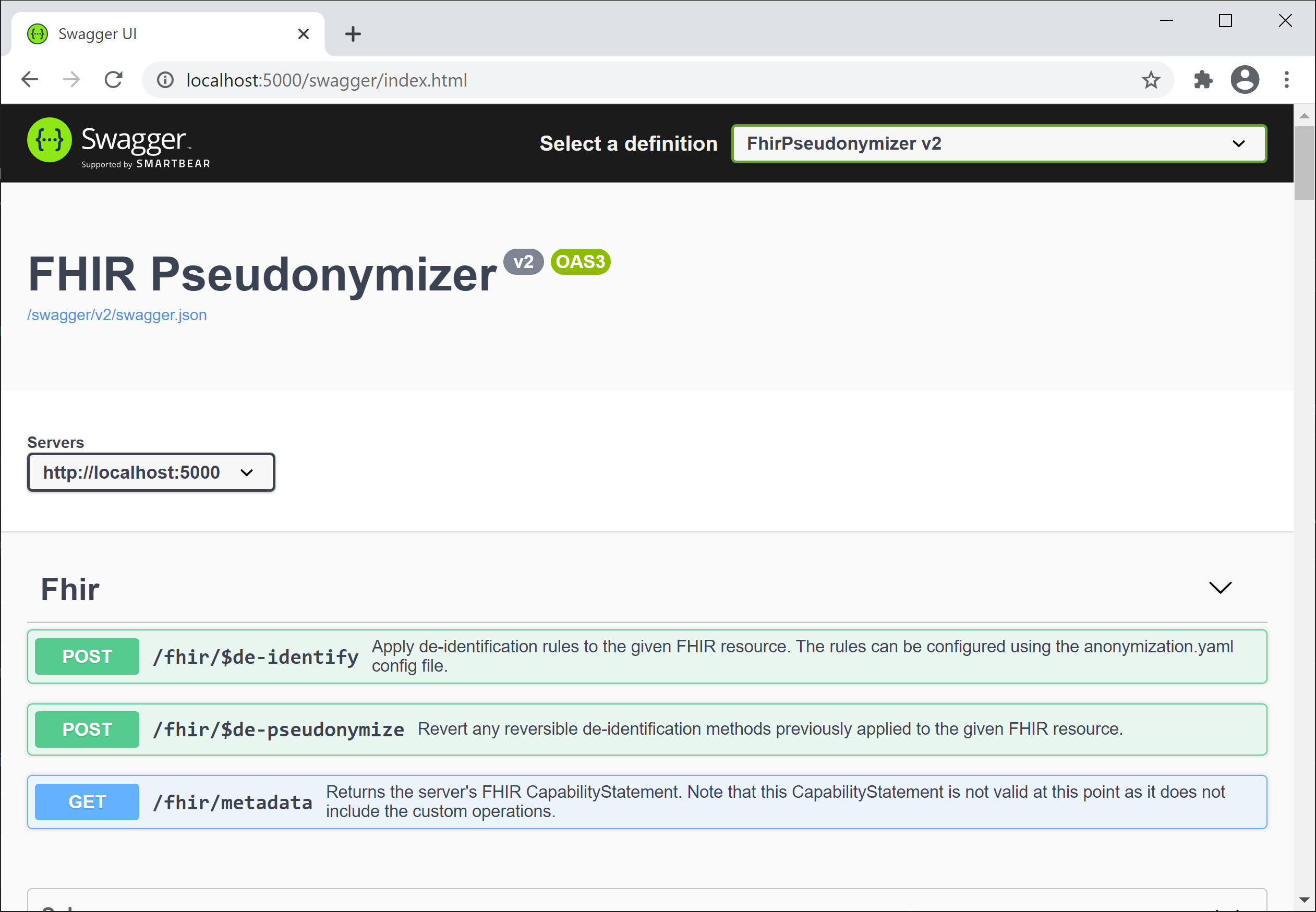
The OpenAPI definition of the FHIR operation endpoints is served at http://localhost:8080/swagger/:
Docker Compose
The compose folder contains a stack that uses an example anonymization config based on the HIPAA Safe Harbor rules:
Open http://localhost:8080/swagger, or POST any FHIR resource to
http://localhost:8080/fhir/$de-identify.
Kubernetes
The recommended deployment is on Kubernetes. Use the Helm chart.
Next steps
- Write rules for your data: De-identification.
- Create reversible, consistent pseudonyms: pick a pseudonymization service.
- Set keys and other options: Configuration reference.
- Process messages from Kafka instead of HTTP requests.